


Blog
Can You Fix Ears That Stick Out Without Surgery? | Stick Out Ear Guide

Can you fix ears that stick out without surgery?
Many parents of newborns notice a stick out ear and hope to avoid surgical procedures. Non‑surgical correction is achievable for qualified infants, yet it is not a universal solution for every age or ear condition. Success depends heavily on the baby’s cartilage state, deformity type, and timely intervention. It is important for caregivers to understand both possibilities and clear boundaries before pursuing non‑surgical reshaping for a stick out ear.
How non‑surgical correction works for a Stick Out Ear
Non‑surgical reshaping uses soft external molding hardware instead of scalpels. It holds the ear in a natural resting position close to the scalp and gently rebuilds the missing inner cartilage fold. With consistent day‑and‑night wear over multiple weeks, pliable neonatal cartilage hardens into the corrected shape, creating permanent improvement for a stick out ear without incisions or anesthesia.
What biological feature makes non‑surgical reshaping possible for stick out ear?
Residual maternal hormones after birth keep infant ear cartilage high in hyaluronic acid. This biochemical condition makes cartilage soft and responsive to steady mild pressure. This temporary pliability is the foundation of non‑surgical stick out ear correction. Once hormone levels drop, cartilage becomes rigid and can no longer remodel under external force.
Eligibility requirements for non‑surgical stick out ear treatment
Non‑surgical methods apply to stick out ear caused by folded but fully‑formed auricle tissue. This deformity develops mainly from intrauterine pressure rather than missing tissue. The infant must have intact, healthy ear skin without scratches, eczema or active inflammation to safely use molding accessories.
Which stick out ear cases cannot be improved with non‑surgical methods?
Non‑surgical molding cannot help ear malformations with partial missing tissue. If the stick out ear appearance comes from severely under‑developed ear structures, external tools cannot generate new cartilage. These complex cases need reconstructive evaluation from pediatric plastic specialists instead of home‑based molding.
Time limits for non‑surgical stick out ear reshaping
The highest‑success golden window for treating a stick out ear runs from 72 hours up to 6 weeks after birth. Cartilage stays most flexible during this period, delivering higher success rates and shorter treatment cycles. Outcomes gradually decline as each additional week passes by.
Can non‑surgical tools deliver results for babies older than 3‑months‑old with stick out ear?
After three months of age, most infant ear cartilage has finished hardening. Molding products can only create temporary positioning. After removing the device, the stick out ear will spring back to its original outward‑angled shape. Permanent non‑surgical correction is generally no longer feasible at this stage.
Common non‑surgical tools for stick out ear correction
Available non‑surgical options include complete molding kits combining soft silicone conformers and hypoallergenic adhesive materials. Some parents purchase standalone correction tapes sold online. Clinical‑grade systems usually offer better structural support compared to simple retail tape products for a stick out ear.
Are adhesive tapes alone enough to fully resolve a stick out ear?
Usually no. Tape mainly serves as a fixing accessory to hold positioning. It lacks structural support to recreate the missing inner anti‑helical fold. Relying only on tape may hold the ear flat against the scalp temporarily, yet it often fails to produce complete permanent correction for a stick out ear.
Realistic expectations for non‑surgical stick out ear correction
Non‑surgical molding brings excellent results for eligible newborns, but perfect symmetry cannot be guaranteed for every infant. Parents should seek pediatric or ENT assessment first to confirm if their baby is a suitable candidate. Avoid delaying evaluation while hoping the stick out ear will self‑fix, as true protruding deformities rarely resolve naturally as children grow.
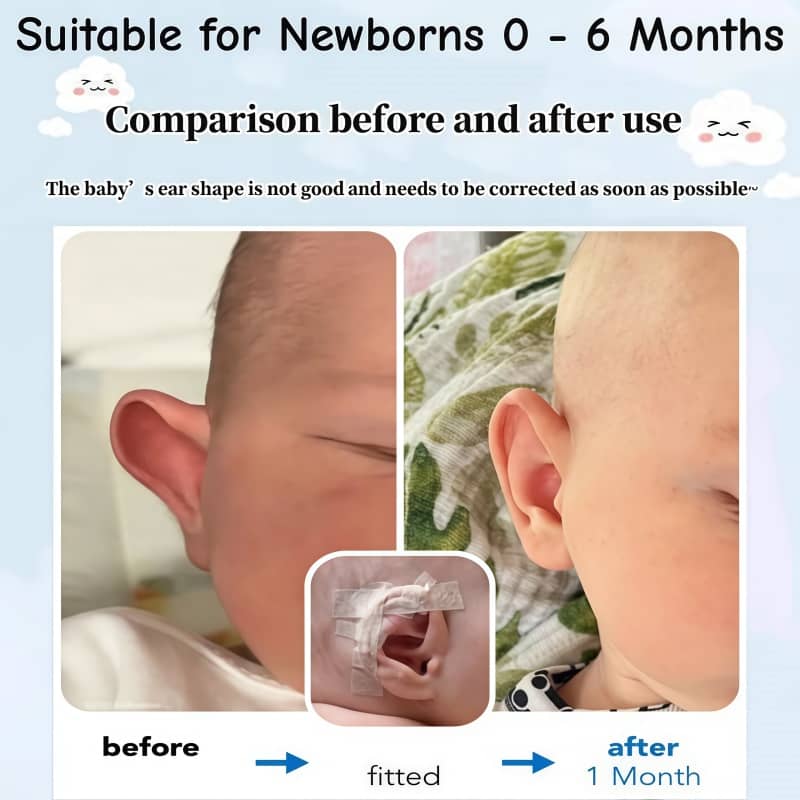
correcting ears that stick out 2