

Blog
The Biomechanics of Early Intervention: Why the Ear Corrector Clip for Baby is a Clinical Necessity

Abstract: Congenital ear deformities, such as Stahl’s ear, cryptotia, and constricted rims, affect millions of newborns annually. Historically, these were treated with “watchful waiting,” leading to traumatic surgeries later in life. This white paper by BabyEarFix explores the mechanical efficacy of the ear corrector clip for baby, the endocrinological window of opportunity, and why targeted molding is the most effective non-surgical path to permanent correction.
1. Defining the Ear Corrector Clip for Baby: More Than Just a Shaper
In the landscape of neonatal ear molding, the ear corrector clip for baby serves a highly specific anatomical purpose. While large base molds provide general scaffolding, the “clip” or “hook” component is designed to address fine-tuning issues, such as reforming the antihelical fold or extending a constricted rim.
1.1 Stress Relaxation and Anatomical Memory
The BabyEarFix clip operates on the biological principle of “Stress Relaxation.” Neonatal cartilage is uniquely viscoelastic. When the ear corrector clip for baby is applied, it provides a consistent, gentle tension that encourages chondrocytes (cartilage cells) to rearrange their internal matrix. Over 14 to 45 days, the ear “forgets” its deformed shape and adopts the correct anatomical memory provided by the clip.
2. The Biological Countdown: The 72-Hour to 6-Week Golden Window
The success of an ear corrector clip for baby is not just dependent on its design, but on the hormonal environment of the newborn.
2.1 The Estrogen-Hyaluronic Acid Synergism
Immediately after birth, a baby’s bloodstream contains peak levels of maternal estrogen. This hormone directly increases the concentration of hyaluronic acid in the ear cartilage, making it as malleable as soft wax.
The Peak Opportunity (First 72 Hours): This is when the ear corrector clip for baby is most effective. Cartilage is at its highest state of plasticity.
The Setting Point (6 Weeks): As estrogen levels drop, the cartilage hardens and the “molding window” closes.
This is why early application of the BabyEarFix system is critical. Waiting until the baby is several months old often renders non-surgical clips ineffective, eventually requiring invasive otoplasty.
3. Resolving the Trust Gap: Safety, Materials, and Modularity
For international distributors and parents, the primary barrier is the “Trust Cost.” BabyEarFix resolves this through engineering transparency.
3.1 Modular Design: The “Single-Use” Rule
Auricular deformities are diverse. A common mistake in the market is using multiple devices simultaneously, which can irritate sensitive neonatal skin. Our clinical protocol for the ear corrector clip for baby is strict: Select whichever one works best for the specific case; they are intended to be used individually, not simultaneously. This modular approach ensures that the clip targets the exact point of deformity while allowing the rest of the ear to breathe.
3.2 Medical-Grade Biocompatibility
Since the ear corrector clip for baby must stay in contact with the skin 24/7, material safety is paramount. BabyEarFix uses only ISO 13485 certified, medical-grade silicone. Our adhesives are hypoallergenic and formulated to prevent “pressure sores” or skin maceration, common issues with generic industrial-grade tapes.
4. Evidence-Based Efficacy: Avoiding the Trauma of Otoplasty
Surgical correction for children (usually performed at age 5 or 6) involves general anesthesia, potential scarring, and significant psychological stress due to the visible deformity during early childhood.
4.1 Citing Global Research
Research published in Plastic and Reconstructive Surgery proves that non-surgical molding with a professional ear corrector clip for baby has a success rate exceeding 95% when initiated within the Golden Window. By choosing a non-invasive path, parents eliminate the surgical risk and ensure their child grows up with a natural, healthy appearance.
5. FAQ: Expert Guidance for BabyEarFix Users
Q: Is the ear corrector clip for baby painful? A: No. Because we utilize the high malleability of the 72-hour window, the clip uses micro-pressure that is virtually undetectable to the infant. Most babies feed and sleep normally throughout the treatment.
Q: Can I use the clip and the base mold together? A: No. To protect the baby’s skin and maintain anatomical accuracy, you must select whichever one works best for the specific case; they are intended to be used individually, not simultaneously.
Q: How long does the correction take? A: Depending on the severity and the baby’s age at start, it typically takes between 2 to 6 weeks for permanent results.
Q: Are the results of the ear corrector clip permanent? A: Yes. Once the cartilage hardens at the end of the treatment, the ear will retain its new shape for life.
6. Conclusion: A One-Time Opportunity for Permanent Correction
The existence of the 72-hour to 6-week Golden Window is a biological “one-time offer.” By utilizing a professional ear corrector clip for baby during this brief period, parents can provide their children with a permanent, non-surgical solution.
At BabyEarFix, we are committed to providing the world’s leading technology for neonatal ear molding, ensuring every child starts life with confidence.
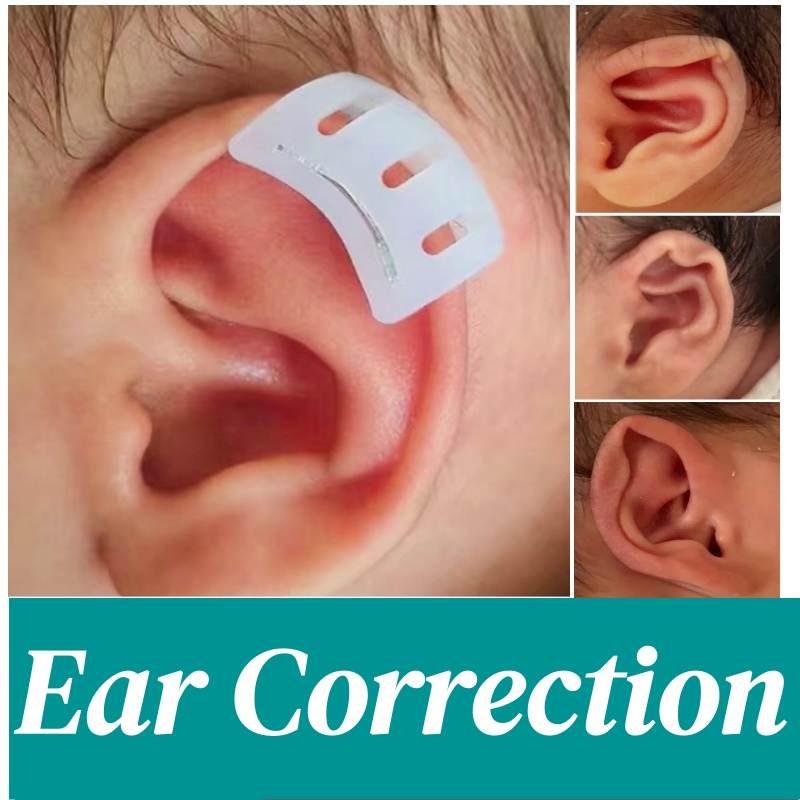
How-to-apply-ear-corrector-clip-for-baby-on-newborn-cartilage