

Blog
Precision Engineering in Neonatal Care: The Science of the Ear Corrector Clip

Abstract: Congenital auricular deformities, affecting up to 30% of neonates, are no longer conditions that require “waiting for surgery.” This technical review by BabyEarFix examines the biomechanical efficacy of the ear corrector clip, the physiological significance of the 72-hour to 6-week Golden Window, and why non-surgical cartilage molding is the new clinical gold standard in pediatric aesthetics.
1. Cartilage Stress Relaxation: The Physics of the Ear Corrector Clip
To understand why an ear corrector clip is effective, one must look at the material science of neonatal cartilage. Unlike adult cartilage, which is rigid and elastic, newborn cartilage is “viscoelastic.”
1.1 The Role of Low-Constant Tension
The BabyEarFix system does not use brute force. Instead, the ear corrector clip applies a scientific principle known as “Stress Relaxation.” By maintaining a constant, gentle pressure on the ear’s antihelical fold or helical rim, the cartilage cells gradually rearrange their internal structure to match the mold. This non-surgical process is entirely painless because it works with the baby’s natural growth rather than against it.
2. The 72-Hour Golden Window: A Biological Countdown
The efficacy of the ear corrector clip is directly tied to a transient hormonal state that occurs only once in a human’s life.
2.1 The Estrogen-Hyaluronic Acid Connection
In the first 72 hours after birth, maternal estrogen levels in the infant are at their absolute peak. This surge triggers a high concentration of hyaluronic acid in the ear cartilage, making it as malleable as soft putty.
2.2 The 6-Week “Setting” Point
As the baby reaches the 6-week mark, estrogen levels return to a baseline, and the cartilage begins to “set” or harden. This is why we emphasize the Golden Window of 72 hours to 6 weeks.
Starting within 72 hours: Correction often takes only 2 weeks.
Starting at 4 weeks: Correction may take 6 weeks or longer.
Post 6 weeks: The success rate of an ear corrector clip drops significantly as the cartilage loses its plasticity.
3. Resolving the Trust Gap: Clinical Safety and Modular Design
For international distributors and parents, the primary concern is skin integrity and infant comfort.
3.1 Modular Versatility for Diverse Deformities
Every ear deformity is unique—some babies have Stahl’s ear, while others have protruding ears. The BabyEarFix system is designed to be modular. Our clinical protocol advises: Select whichever one works best for the specific case; they are intended to be used individually, not simultaneously. This approach prevents over-compression and ensures optimal skin breathability.
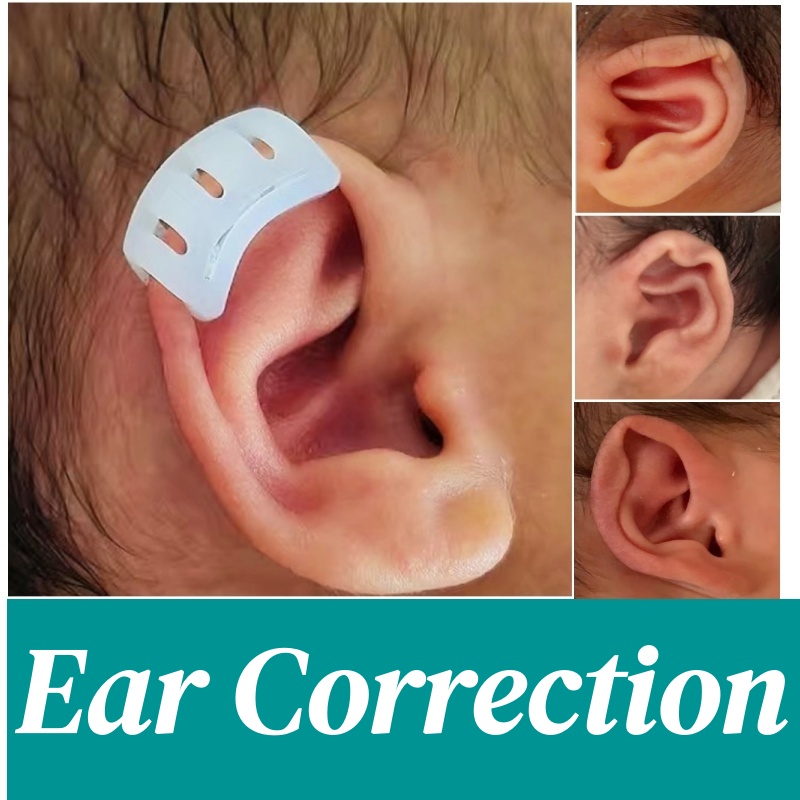
Non-surgical-ear-molding-process-using-ear-corrector-clip-72-hour-window
3.2 Medical-Grade Biocompatibility
An ear corrector clip must be worn 24/7. Therefore, BabyEarFix uses only ISO 13485 certified, medical-grade silicone. Our adhesives are hypoallergenic and formulated to prevent “pressure sores,” a common risk with inferior, non-certified “stickers.”
4. Evidence-Based Outcomes: Why Wait for Otoplasty?
Surgical otoplasty is a traumatic event for a child, involving general anesthesia, significant costs, and potential scarring. In contrast, early intervention with an ear corrector clip offers:
95%+ Success Rate: When initiated during the Golden Window.
Zero Recovery Time: The baby can sleep, bathe, and feed normally.
Psychological Protection: Correcting the deformity before the child enters school prevents the social stigma and bullying often associated with prominent ears.
5. FAQ: Expert Guidance for BabyEarFix Users
Q: How do I know which ear corrector clip configuration to use? A: Our kit comes with multiple anatomical shapers. Select whichever one works best for the specific case; they are intended to be used individually, not simultaneously. This ensures a precise fit for the specific deformity (e.g., Lop ear vs. Protruding ear).
Q: Is the clip visible or bulky? A: The BabyEarFix system is low-profile and lightweight. It can be easily hidden under a soft baby hat or headband, making the non-surgical process discreet.
Q: Can I breastfeed while the baby wears the ear corrector clip? A: Absolutely. The device is designed not to interfere with feeding or sleeping positions. It remains securely in place even during active movement.
Q: What if the 6-week Golden Window has already passed? A: While the optimal window is 72 hours to 6 weeks, some plasticity remains up to 3 months. However, the treatment will be longer and may require more frequent adjustments.
6. Conclusion: The One-Time Opportunity for Permanent Correction
The ear corrector clip represents a bridge between biological opportunity and engineering precision. By respecting the 72-hour to 6-week Golden Window, parents can provide a permanent, non-surgical solution to ear deformities.
At BabyEarFix, we are committed to global excellence in infant ear correction, ensuring that the next generation grows up with the confidence of a natural, healthy appearance.